How Hesed World’s career positioning cohort helped young people rethink their experience and opportunities
Updated: Aug 3
SPOTLIGHT ON
For many young people, the challenge is not a lack of ambition. It is often the difficulty of understanding what their existing experience means, where their skills can take them, and how to identify opportunities that genuinely align with their abilities and aspirations.
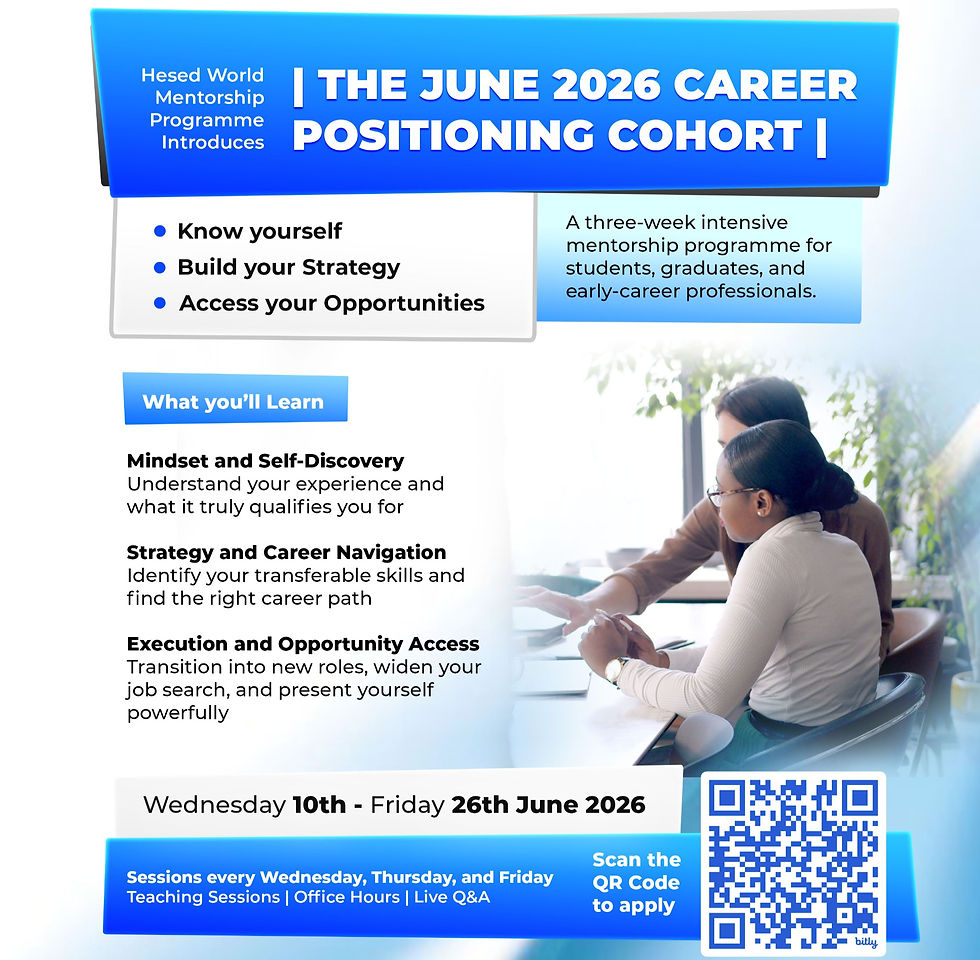
This was the challenge that led to the development of the Hesed World career positioning cohort, a three-week career development and mentorship programme held from 10 to 26 June 2026.
The programme was created from a question that emerged within Hesed World’s youth community: Why were young people not applying for opportunities that appeared to be relevant to them?
The question became particularly important because Hesed World already had an opportunities group within its youth community, where jobs, internships, scholarships, and other opportunities were regularly shared. Yet, despite having access to these opportunities and having previously participated in sessions on CV and LinkedIn optimization, many young people still did not feel confident enough to apply.
Some said they did not feel qualified. Others were unsure whether their previous experiences were relevant to the opportunities they were seeing. For many, the challenge appeared to go beyond simply knowing how to write a CV or apply for a job.
Listening before designing
Rather than assuming what young people needed, Hesed World decided to investigate further.
An initial survey was conducted with 30 members of the community to better understand the barriers preventing young people from applying for opportunities and making confident career decisions. The survey played an important role in validating the problem and shaping the programme that followed.
The findings revealed two key challenges.
First, many participants struggled to understand what their existing experiences qualified them for. They often did not recognize the transferable skills they had developed through their education, employment, volunteering, community involvement, or other experiences.
Secondly, many participants had a narrow understanding of where opportunities could be found. Their job search was often limited to conventional job postings, while they remained unaware of the wider range of opportunities available across different sectors, organizations and professional pathways.
The survey also revealed the diversity of the community. Responses came from people at different stages of their professional journeys, including teachers, experienced professionals, people with years of work experience, and individuals considering a transition into a completely new field.
This meant that the programme needed to go beyond a one-size-fits-all approach.
The findings helped Hesed World develop a three-week cohort designed to take participants through a journey from greater self-awareness to career clarity, transferable skills, and opportunity access.
A three-week journey towards career direction
The programme was structured around three broad stages.
Week one focused on mindset and self-awareness.
The programme began with an onboarding session led by Kiki Lawal, founder and president of Hesed World, who played an important role throughout the cohort. Through the opening session and the broader programme journey, participants were encouraged to reflect on their experiences, understand their current position, and begin thinking more intentionally about the direction they wanted their careers to take.
The first substantive session was led by Dr Fulata Lusungu Moyo, a human rights specialist and author, who challenged participants to think more deeply about what their experiences could qualify them for. The session encouraged participants to look beyond job titles and conventional definitions of experience, and to recognize that the skills developed through different life and professional experiences can open doors to opportunities they may not have previously considered.
The week concluded with an office-hour session, providing participants with the opportunity to ask questions and receive further guidance on their individual career concerns.
Week two moved from self-awareness to strategy.
Participants were encouraged to begin translating their experiences into a clearer professional direction.
Giovanni Francesco di Cola, PhD, CEO of BSAS221, adviser of Unio ch1, and mentor and board member of Greycells, led a session on identifying and communicating transferable skills. His session focused on helping participants understand how to recognize the skills they have developed through their experiences and how to communicate them effectively in CVs, applications, and professional conversations.
The session addressed an important challenge identified through the initial survey: many people have valuable experience but struggle to explain why that experience matters.
The week also featured Cyrille C. Catel, founder and CEO of APX Vision, who led a session on finding the right career path. The session encouraged participants to move from confusion to greater clarity by reflecting on their interests, strengths, and possible career directions.
The week concluded with an office-hour session led by Debbra A.K. Johnson, risk and resilience advisor at ARISE (USA). The interactive session allowed participants to raise questions about career decisions, transitions, professional growth, and the challenges they were personally facing.
Week three focused on opportunities, career transitions, and the wider possibilities available to participants.
Hiromi Amano, youth engagement analyst at UNDP, led a session on widening the job search and presenting oneself professionally. Drawing from her own career journey - from a small town in Yamanashi, Japan, to working internationally with the United Nations Development Programme - she encouraged participants to think beyond the opportunities they already knew about.
Her session highlighted the importance of broadening one's search, exploring different channels and understanding how to position oneself for opportunities across sectors and geographical locations.
Participants were then guided through the realities of moving into a new role or industry by Dale Sands, principal managing director of Sands Consulting Solutions LLC. The session focused on career transitions, adjacent skills, and how professionals can build credibility when moving into a new field without necessarily starting from zero.
The programme concluded with a special session led by Professor Emeritus Claude Sobry, founder and president of the International Research Network in Sport Tourism (IRNSST) and a member of Greycells.
His session explored sport tourism, the opportunities emerging within the field, and the different career possibilities available to people who may not have previously considered the sector as part of their professional pathway.
The closing session also provided an opportunity to reflect on the programme, hear from participants about their experiences, and consider the next steps beyond the cohort. Kiki Lawal, founder and president of Hesed World, contributed to the closing of the programme with encouragement and reflections for participants as they continued their career journeys.
A programme that reached beyond borders
The Career Positioning Cohort attracted 669 registrations and brought together participants from 10 countries: Benin, Ghana, Ireland, Kenya, Liberia, Malawi, Nigeria, Rwanda, South Sudan, and the United States.
Across the programme, an average of approximately 200 participants engaged
with the sessions. While attendance naturally varied from session to session, the programme created a space for young people and professionals at different stages of their careers to learn, ask questions, and reflect on their next steps.
The diversity of the participants was one of the strengths of the cohort. People joined with different experiences, backgrounds, and career ambitions. Some were just beginning their professional journeys. Others were already experienced professionals considering a transition into a new role, sector, or industry.
This diversity reinforced the importance of career positioning.
Career development is not only about finding a first job. It is also about understanding how to build a career intentionally, how to recognize opportunities, how to communicate one's value, and how to make informed decisions when the next step is not immediately clear.
Moving from learning to action
The programme did not end with the final session.

Participants were encouraged to reflect on their learning and share their experiences publicly, including through LinkedIn posts about their key takeaways from the programme and the ways their thinking had changed.
For some, the cohort helped them recognize that they possessed skills they had previously overlooked. For others, it expanded their understanding of the opportunities available to them and challenged the belief that their career options were limited to one particular field or job title.

The programme also helped reinforce an important principle: career clarity is not always something people find instantly. It is often built through reflection, exploration, learning, and action.
By the end of the cohort, 87 participants had met the 60 per cent attendance requirement and received certificates of completion. However, the impact of the programme went beyond the number of certificates issued.
The more important outcome was the opportunity to help participants ask better questions about their careers.
What does my experience qualify me for?
What skills have I developed without realizing it?
What other opportunities are available to me?
How can I position myself for the career I want?
And perhaps most importantly, what would happen if I stopped viewing my experience as limited and started seeing it as a foundation for what comes next?
The Hesed World Career Positioning Cohort was designed to help participants begin answering these questions.
From the initial survey of 30 community members to 669 registrations from across 10 countries, the programme demonstrated the value of listening before designing. The challenges identified within the community shaped the programme, and the programme created a structured pathway to address them.
Over three weeks, participants moved through a journey of self-awareness, career discovery, transferable skills, professional positioning, job-search strategy, and career transitions.
The journey may have ended on 26 June 2026, but the intention is that the conversations, questions, and new perspectives developed through the cohort will continue to shape the career decisions participants make long after the programme has ended.
At Hesed World, we believe that young people should not only be encouraged to pursue opportunities. They should also be equipped to recognize the opportunities that may already be within reach, understand the value of what they bring, and build the confidence to take their next step.